
Ad Tech, which Creates 'Audience Balkanization,' is Ineffective for Many Advertisers and Unhealthy for Democracy
Ad tech is low cost, but it is not effective in driving brand growth for many advertisers. In politics, it fosters unhealthy polarizations. Madison Avenue is complicit in expanding its capabilities.


Credit: Edward Koren, The New Yorker, The Cartoon Bank
The marketing industry’s love affair with ad tech seemed necessary and inevitable after 2009.
After all, media had evolved from mass television to cable television to streaming. TVs, laptops, iPads and mobile telephones provided the diverse screens. Google, Facebook, Amazon and Apple collected enormous amounts of social, behavioral, spending, search and demographic information, and these same Big Tech players developed ad tech ‘plumbing’ to permit automated real time auctioning and massive ad placement across the web, much of it to dark and undesirable places.
Wasn’t this the inevitable march of technology? Wasn’t targeted, individualized advertising better than bland, general mass market advertising?
Programmatic advertising was certainly cheaper and faster, and ‘principal media trading’ allowed media agencies to make trading profits that more than compensated for the lousy media fees paid by their clients. Wasn’t this a good thing?
The counter-argument is that there is very little evidence that programmatic advertising drives brand sales for legacy advertisers. Analyses of the revenue performance of the top 60 advertisers between 2009 and 2024 show that 40 advertisers, or 2/3rds of this group, all of them major programmatic users, saw their growth rates fall below nominal GDP growth rates from 2009-2024.
Prior to their adoption of programmatic advertising, these advertisers grew strongly.
There are factors other than programmatic advertising that influence revenue growth, of course. But nevertheless, the growth case for programmatic is not an easy one to make. The so-called superiority of targeted advertising has yet to be proven. Metrics based on clicks and attribution assumptions are flawed (even if they are beloved by Big Tech players, who have a lot of financial reasons to love this approach).
The most reliable metric is revenue growth, and the evidence is that brand revenue growth has not been enhanced by the shift to programmatic.
The ad tech plumbing, along with data collected principally by Google / Meta / Amazon / Apple and platforms like Epsilon and Acxiom allow large consumer markets to be disassembled and then reassembled into homogeneous ‘bubbles’ for marketing (and political communications) purposes.
Audience Balkanization
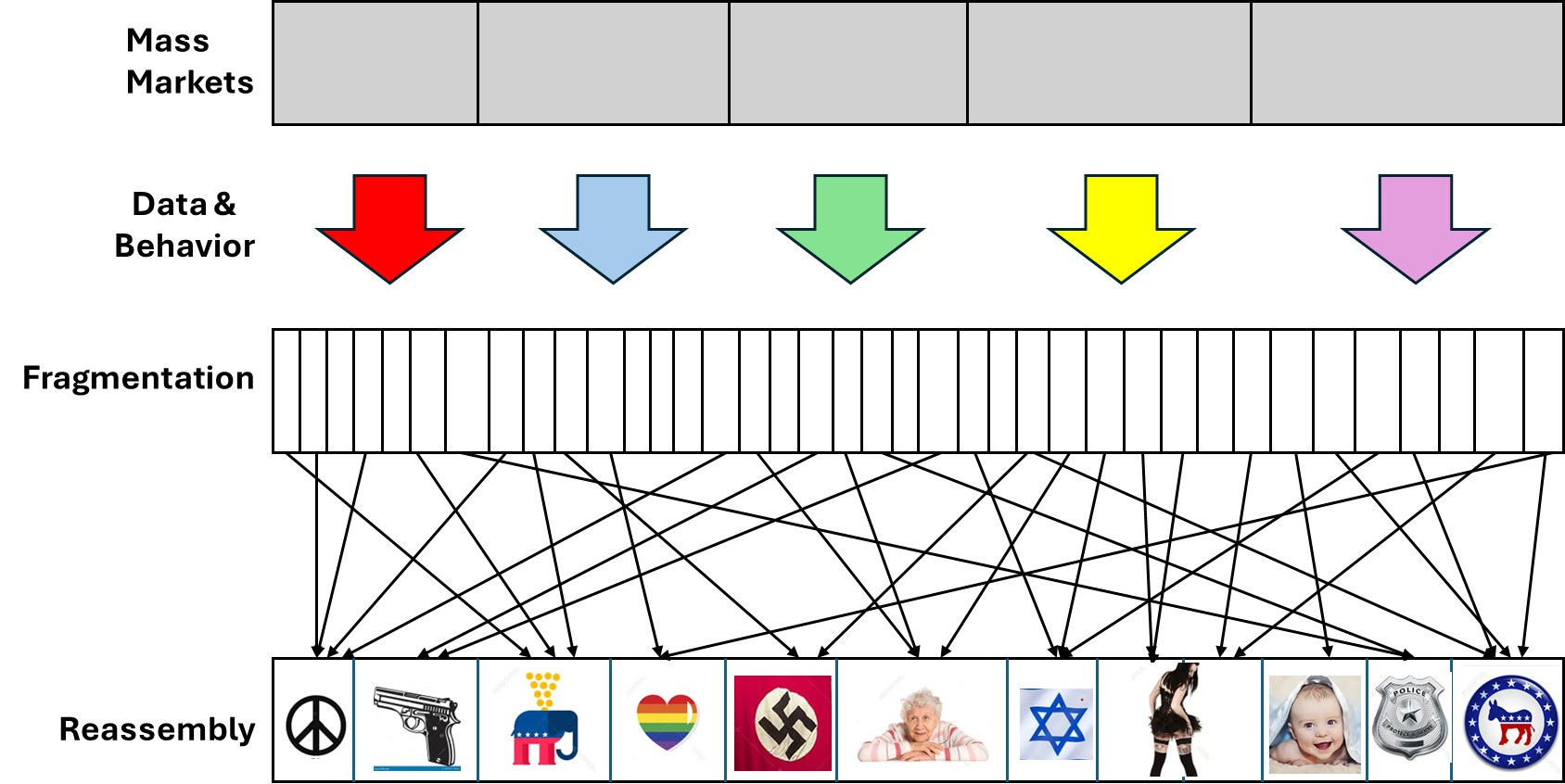
The bubbles are separate marketing worlds that have little in common with the other marketing worlds and have no need converse with them. The bubbles do not exist for this purpose.
For advertisers, what matters is the efficiency with which products and services can be pitched to each unique bubble, using unique messages and positioning, leading members of each bubble to take desired actions — like buying the advertised products.
For political parties or movements, what matters is the degree to which each bubble can be exploited separately, via storytelling and ‘facts,’ for donation and voting purposes. In addition, of course, political bubbles are encouraged to hate, rather than disagree with the bubbles with whom they compete.
In a democracy, there’s a need for individuals and groups to engage in civil public discourse, discussion and debate, leading to compromises that advance the general welfare.
Unfortunately, though, the division of the country into political ‘bubbles’ that have no capability to communicate, debate or compromise runs counter to the needs of democracy. This takes us in the wrong political direction.
You could argue that product marketing via Audience Balkanization is benign (whether it works or not), whereas political marketing via Audience Balkanization is unhealthy and self-destructive. Political Balkanization paralyzes the democratic process.
Product marketing’s use of MMM (marketing mix modeling) platforms may well show, as I believe it will, that programmatic advertising is not terribly effective, and that advertisers will return to broader forms of marketing that enhance brand equity and sales.
This would be a welcome development in product marketing.
As far as political marketing is concerned, though, the use of programmatic marketing may be hard to get rid of.
The technology that allows programmatic advertising to exist, enriching Google, Meta, Amazon and others remains a dangerous virus in a demographic society. There is so much money in the pipeline that it will not be abandoned.
The country is polarized not because people disagree. People in different bubbles never hear the same arguments or evaluate the same data. They live in different worlds.
Everyone gets a different story, and no one can see what the others are being told.
And they’re all taught to hate each other.
Programmatic advertising has led the way by providing the technology, the resources and the momentum….along with positive spin about how great it is.
Madison Avenue is complicit in the political paralysis of our current times.
If the genie could be put back in the bottle…we’d all be in a better place.
Great post Michael and certainly food for thought. A counter-argument though: those brands that have not grown despite programmatic spend have probably been impacted by more competition - challenger brands that have used the adtech pipes (and social ads) to challenge the incumbents. In some ways it could prove the effectiveness of programmatic advertising if we could measure against competitors as a whole.
Programmatic advertising is mostly a scam. It looks good on paper (excel) because it's cheaper and is, in theory, hyper-segmented but the reality is that a large chunk of it is pure fraud, while the rest is cheap or second-rate inventory that the publishers cannot package in a more premium way.
It's literally the outlet of advertising, where CPM is bought on the cheap. BTW, Programmatic is usually bought on a CPM basis so it's not really geared towards conversion. It's more a way to put some extra gazillions of impressions on those excel files.