

Credit: Benjamin Schwartz, The New Yorker, The Cartoon Bank
Phil Dusenberry, the former Chairman of BBDO North America, coined the phrase “The work, the work, the work” for BBDO in 1996, and this famous phrase served as BBDO’s guiding philosophy until the agency replaced it in 2025.
“The work, the work, the work” was a proud battle cry, not a complaint that “there’s too much work in our SOWs, and we can’t handle it!”
No, BBDO was proud of the fact that its creatives would work the work until it was perfect. “We work, we work, we work to get it right,” they bragged! “That’s why we win so many creative awards!”
How quaint this phrase was. In 1996, the price for a uniform mix of agency deliverables was 3x today’s price. No wonder rework was just fine! It was affordable! The price for 1996 creative work was exceptionally high!
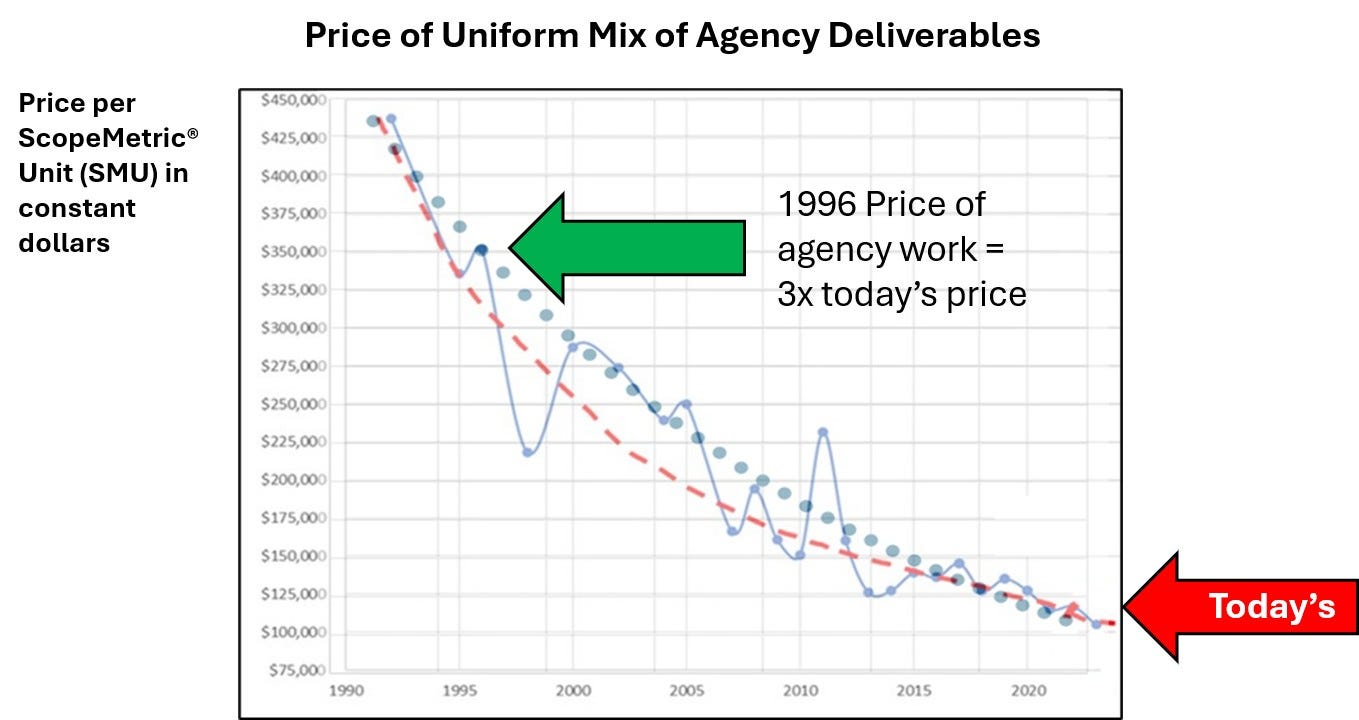
Source: Farmer & Company creative agency clients
Today's Price of $110,000 per SMU is really too low,
and it’s low because there are excessive deliverables and excessive work in the SOWs.
If fee levels remained where they are, and SOWs were cut by 33% (which they should be)
the Price would be about $160,000 per SMU, which is where it should be.
Today, under the threat of AI, agencies are thinking about (but not rushing to implement) output-based prices. They can’t afford the work, the work, the work unless clients are paying for excessive rework.
When this is the case, agencies are happy. A paid hour for rework is as good for agencies as a paid hour for an ad, at least for the agency finance people
For the clients, though, paid-for extra rework is a real drag.
ScopeMetrics®AI, the SOW documentation and measurement tool used by Farmer & Company’s and TrinityP3’s clients, calculates output-based prices for agencies and their clients.
The results are fascinating. Output-based pricing allows ScopeMetrics®AI to calculate the cost of extra rounds of rework.
If advertisers and agencies were aware of how costly rework is, they might take steps to improve briefing and ad approval processes.
Cost of Extra Rework: TV:30 example
Let’s take a typical original TV:30 spot. ScopeMetrics®AI can calculate the results for an assumed cycle involving one creative team, supported by client service, strategic planning and production FTEs:
The agency is briefed by the client.
The creatives set about to develop the storyboard and script, using online creative development tools.
This is the initial round of creative development, and it goes through some internal reviews within the creative department and with client service executives.
When it’s deemed ready, it’s reviewed with the client, and the agency is redirected to do some edits and rework.
This leads to the first round of normal rework, which is equal in effort to the initial creative development effort.
After this rework is done, the creative development goes back to the client for a second review.
This leads to a second round of normal rework.
When this is done, back to the client for approval and permission to enter the production phase. Let’s assume that Production is overseen by the agency’s production people, along with the creatives, and a production company will be hired for the actual shoot.
At the shoot, and during the editing, the creatives continue to work on the brief.
Production generates a third creative rework process.
All of this is entirely normal and expected.
A crude simplification: one creative development and three reworks
Initial creative development by the creatives.
Review, leading to the first normal rework.
Review, leading to the second normal rework.
Approval, leading to the third normal rework during production .
Roughly speaking, there are four rounds of creative effort.
Fee for one TV:30 origination
At an average billing rate of $160 per hour (just an assumption), ScopeMetrics®AI calculates a price of $168,526 for a TV:30 origination for which there are two normal reworks with the production supervision and ongoing creative involvement in-house.
If we roughly assume that the initial creative development and each of the three reworks are of equal size — four rounds of agency effort — then the cost of each round is $42,131.
Presumably, an additional rework would add an additional $42,131 cost to the deliverable, either paid for by the client (bringing the output price to $210,657) or eaten by the agency.
Extra rework takes extra people, extra hours and extra costs. The costs are excessive. Too little effort is devoted to fixing the rework problem.
Procurement, in its chronic desire to lower agency fees, might do better to focus on reducing rework by improving advertiser briefing and ad approval processes.
Blindly bashing agency fees is not the solution.
Madison Avenue Revisited (2026)
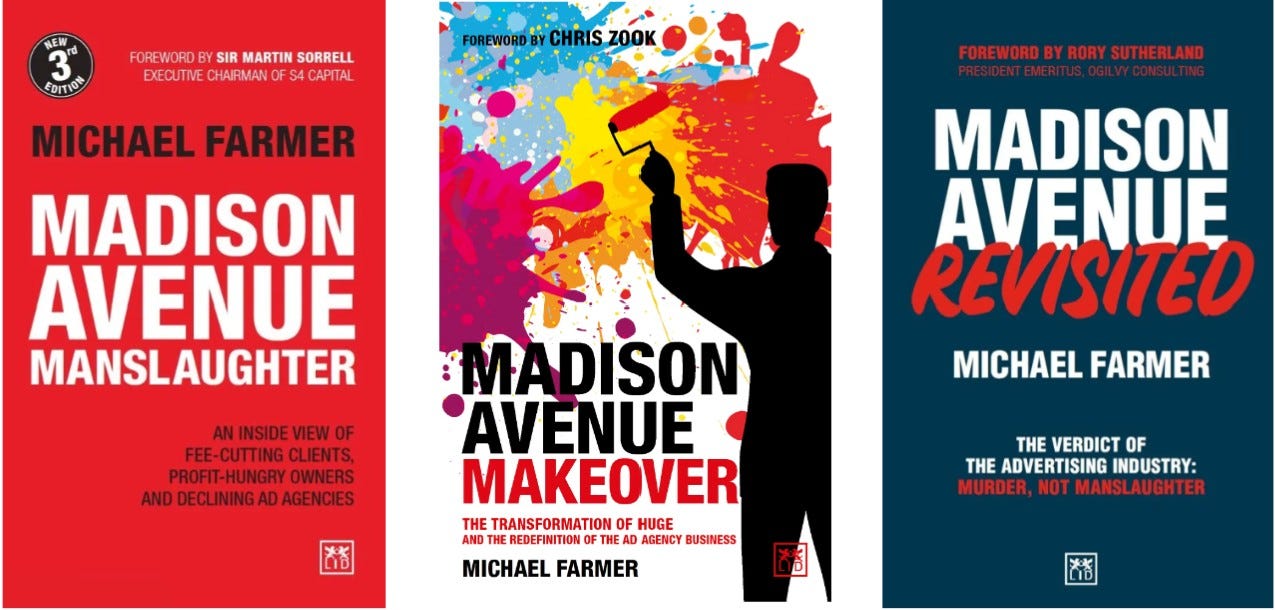
My third book about the advertising industry, Madison Avenue Revisited, is available on Amazon. The book, which focuses on the deterioration of client-agency relationships and the brand growth challenges faced by clients was launched at Cannes this year. Foreword by the inimitable Rory Sutherland of Ogilvy Consulting.
Fully agree. But this can only be fixed on a case by case basis with third party intervention. Otherwise, the client agency power imbalance will sabotage the best intentions.
Michael, the agency finance people are right that a paid hour of rework is as good as a paid hour of origination, until somebody tries to buy the agency. A buyer asks how much of the profit comes from rounds the client would stop paying for the day it fixed its briefing, or moved to a price per output. That part of the margin is on loan. It gets marked down, or pushed into the part of the price that is paid later, if at all.
So the owner has a reason of their own to want rework measured. In PR, the trade I know, the retainer is fixed and the fourth draft comes out of the agency's margin instead. The same disease, except that nobody sends the client the bill.