
Orwellian "Doublethink" and Programmatic Advertising
Doublethink: the ability to hold two contradictory ideas at the same time and accept both as true.

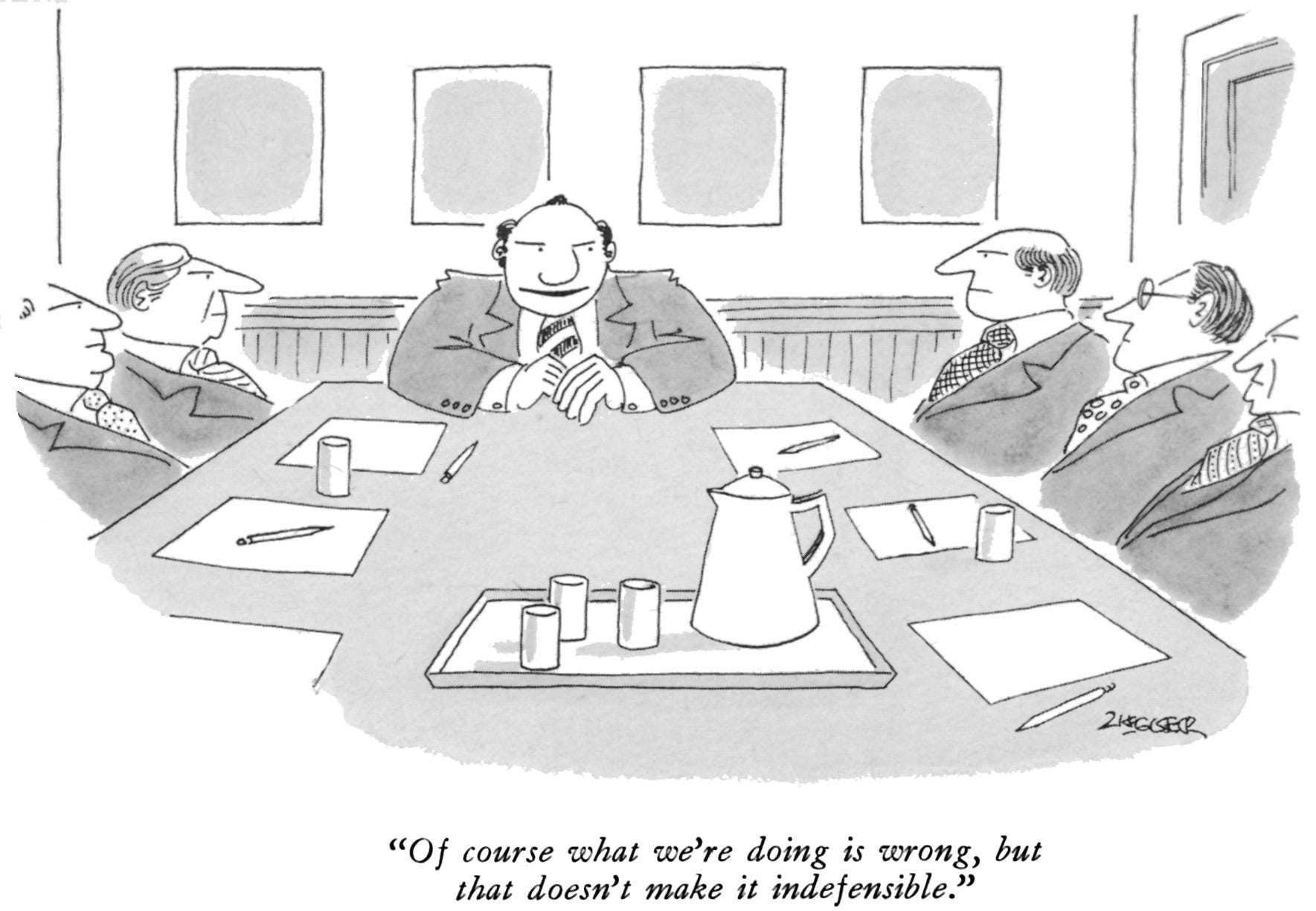
Jack Ziegler, The New Yorker, The Cartoon Bank
Doublethink, from George Orwell’s 1984, is a core tool within an authoritarian system:
“To know and not to know, to be conscious of complete truthfulness while telling constructed lies, to hold opinions which cancel out, knowing them to be contradictory and believing in both of them…”
Doublethink is a survival skill in systems where the truth is dangerous.
Under what doublethink assumptions is programmatic advertising seen as “good?”
Programmatic is successful in generating income for Big Tech, particularly for Google, Meta, Amazon, data providers and martech infrastructure owners. Anyone beholden to or involved with Big Tech sees programmatic advertising as “good.” (What must be ignored is that the publishers and agencies are being starved of revenue by Big Tech...and agencies will be eventually squeezed out by Big Tech.)
Programmatic shows positive metrics for the measures established by Big Tech and its supporters, particularly clicks and last-touch attribution measures. (What must be ignored is that these metrics are irrelevant for measuring brand growth, which is the ultimate measure of advertising success.)
Programmatic is a low-cost form of advertising, which is “good” for the majority of advertisers, who have had growth problems for the past 15 years and need low costs to enhance their otherwise challenged margins and stock prices. Anyone who works on behalf of advertisers sees programmatic advertising as “good” in this respect. (What must be ignored is that helping advertisers grow would be superior to helping them respond to low growth.)
Programmatic is “good” for holding companies, who can buy programmatic inventory in advance and mark it up for sale to clients, thus making non-transparent profits that they would otherwise not make as a result of their poor pricing of labor-based operations. (What must be ignored are the serious reputational conflict of interests created by principal media, and the greater opportunities if holding companies were to fix their pricing strategies.)
Programmatic supports employment at advertising agencies. (What needs to be ignored is the ease with which AI will kill programmatic employment and labor-based fees.)
What is the truth about programmatic advertising?
Programmatic does not drive brand growth or enhance brand equity, forcing advertisers to revert to low cost strategies.
Programmatic places too many ads in too many undesirable and questionable places, wasting advertisers’ money and undermining past marketing investments in brand equity.
Programmatic floods the market with uncreative and interruptive ads that increase audience disrespect for and annoyance with advertising.
Programmatic’s ineffectiveness in driving brand growth undermines client respect for agency value and capabilities, leading clients to change agencies too frequently, raising agency costs.
I could go on with both lists, but I would not be telling you anything you do not already know.
You already know the truth about programmatic, but you work to facilitate its increased use by agencies and their clients.
Doublethink about programmatic advertising is chronic in the advertising industry.
Living with and working on programmatic advertising is like living in Winston Smith’s 1984 world, where being vocal about the truth would be dangerous.
Losing your job is today’s punishment. Given the meager employment prospects in today’s industry, losing one’s job is a serious punishment, indeed.
Google, Meta, Amazon, CMOs and C-Suite executives at the holding companies play the role of Big Brother. Big Brother needs to be pleased. Big Brother has a lot of power. Big Brother is watching you.
Today’s agency executives lead a doublethink existence: they must know and not know, think and not think, work with commitment and admit to no one the uselessness of much of what they do.
Truth, in today’s advertising industry (and in our government) is in short supply.
In today’s doublethink industry, advertising is seen as effective, holding companies are successful and doing even more wonderful things, ads are creative and interesting, and a lot of value is being created for clients (even if they do not pay for it). AI, which is already present, will bring even more value to the industry and make the holding companies even more successful.
It’s a wonderful and exciting world!
And Trump really did win the election in 2020.
Claiming “efficiency” while budgets vanish into black boxes and publishers starve. But here’s my counter: programmatic’s chaos isn’t fatal design flaw; it’s execution rot. Strip away ad fraud (60%+ of spend in some audits) and holding-company rebate chases, and the model still lifts awareness 15-20% for brands running clean causal MMM, not multi-touch fairy tales. The real Orwellian move is agencies pretending they can’t measure it properly while pocketing the kickbacks.
I share your frustrations about big tech believe me. I have been in MarTech for over two decades.
I have been on all sides of the game- agency, vendor, advertiser.
I started during dot com bust and have seen the evolution of how big tech bought, bullied and lobbied its way into a corrupt monopoly that killed independent MarTech, holding publishers locked in and hostage bleeding dry, and wasting billions in advertiser budgets.
However, where I don’t agree is the fact that programmatic doesn’t generate brand growth or awareness or that it is not measureable with proper causal metrics (what you are citing in your article is correlational attribution where each platform takes credit and doesn’t mean anything)
Those of us ethically working in MarTech (and you can find many) that aren’t tied to big holding company kick backs and rebates, outsourced execution, complete incompetency in being able to manage any of the inventory, not being due diligent,have actually been running programmatic responsibly and seeing effective returns for a long time.
Ad fraud is the biggest money pit when it comes to programmatic. The tech that is out in the market claiming they work on brand safety and fraud are not equipped to do that job- hence law suits coming up.
I agree there are issues on all sides of the equation.
However, generalizing the entire buy model as useless is not the correct categorization of the reality.